Showing posts with label Andalusia: Cádiz. Show all posts

Saturday, 20 August 2016

Foodie traveller's tips to Cádiz and rest of Andalusian Sherrycountry

For a foodie traveller Andalusian Sherrycountry is a dream. Here are my favourite addresses in South Western Andalusia!

* * * 

Going hungry is something that I really didn't need to worry about during my trip to Andalusian Sherrycountry, a.k.a. tour of Cádiz, Jerez, El Puerto de Santa Marían and Sanlúcar de Barrameda. Somebody made a cautious comment going over blog's Instagram feed wondering if I managed to have time to do anything other than eat. Well, not really. But that wasn't the plan either!


Seeing how my journey took me through the South Western coast, there was also no risk of having to go through a single day without octopus. Oh, no. I kept stuffing my face with that tentacled love of mine like there was no tomorrow. Same thing with Iberico pork. Starting with my daily breakfast bocadillo. 


Oh, Andalusia. I do love you so. 


Let's start the round-up from Cádiz, where I spent most of my time. 

Cádiz:

Most of the best tapas bars are located in the "hand bit" of Cádiz Old Town. One of the most traditional ones is Taberna Casa Manteca, which couldn't be more kitsch retro authentic.

Arrive early as it is wildly popular among the locals and fills quickly.


Another place worth checking out in the neighbourhood is tiny La Tabernita, which has only been open for a couple of years. It's a little edgier and decorated with drawings by the owner Rafa, a great guy and passionate about his wine. 

The menu is short and sweet, but everything on it is good. Like, really good. Tortillitas de camarones, a Cádiz specialty is particularly good, as are albondigas de choco, cuttle fish meatballs. The top chef in charge of the kitchen is top notch, too - she's Rafa's mama. 

You'll find my recipe for the meatballs over here and for tortillitas de camarones over here.


One of the most famous restaurants in the area is El Faro (tasting menus start at €40). Don't expect anything too innovative, but if you're after traditional Spanish treats, you're in for a treat. 

Even bigger recommendation for the bar and their tapas selection. 


Located by the sea across the town there's Balandro, with slighty more modern take on things. The menu combines Spanish traditions with Asian and Middle Eastern influences. Brioche-based French toast with Iberico Bellota, foie gras and apple compote`Every bit as sinfully delicious as it sounds. 

Points for interesting wine and sherry menu.

Another fresher and more contemporary restaurant is  Sopranis, proud owner of Bib Gourmand (tasting menus €50). 


In case you're at all passionate about Iberico, the king of all pigs, you should definitely not miss Meson Cumbres Mayores. Arrive early or better yet, make a reservation. Without one you might still luck out at the bar with a separate tapas menu. 

Not the cheapest choice (though menus start reasonably at €30), but Dios Mios, is it good!


Same street also houses several restaurants specialized in fish and seafood. One good choice is Cerveceria la Gaditana (in business for more than a century!), located just across the street. Their seafood platter (€18) is guaranteed to make any day a good one. 


Oh, and another must for a seafood lover is of course Cádiz central market, where I took you on a tour alread earlier. Pick up goodies for an impromptu al fresco feast or go crazy with the food court where there's something for everyone. 


Another equally good choice is to collect your favourites from the fish market (like those massive prawns, size of my elbow...!) and take the lot to one of the restaurants around the market, where, for a small fee, they'll cook your catch of the day to your liking. 


One of these is  Taberna La Bombilla, where I found myself venturing several times. 

The place managed to surprise me too: I actually discovered seafood I failed to fall in love with. Ortiguilla is a Southern Andalusian specialty: crunchy exterior that hides a snot-like, slimey creature. I can't believe I had to live to see this day: there's  food that isn't salvaged even by deep-frying. Oh, my.

For brutally honest reactions after the first bite, check out blog's Twitter feed...


Another Cádiz delicacy is camarones, tiny, tiny shrimps that are used for making of tortillitas de camarones. They are sold on the streets in snack-sized cones. Sometimes still alive.


The area around market is also full of cafes that, especially during the weekends, area heaing with families gathering foe a churro breakfast. 

Churros are picked up from the churro stalls in the square next to the market, which are then taken to the cafes and devoured over wonderfully rich hot chocolate. Oh. Ah. Make sure to turn up early or you'll have to go without...


Located on the Palaze Ayuntamiento square close to the railway and bus stations there's a delightful jamóneria/ deli El Chicuco, whose Iberico selection and I quickly became best of friends.

A great place to stock up on local goodies. In the evening they also open a small tapas bar next door.


 La Vaca Atada, located across the square on Calle Nueva, became another favourite of mine. They're famous for their Argentinian empanadas, but you should also save some room in your stomach for their pastries, where they haven't scrimped on dulce de leche, caramel made with condensed milk.


And seeing how Andalusians love deep-frying, keep an eye out on for freidurias, specialized in deep-fried fish and seafood. A good one is located on the flower market of Plaza de Las Flores on the square after the market.


Jerez de la Frontera:

While sampling the selection at the local sherry bodegas is a great way to spend a day, you should also make some time for solid food, too and for that there's no shortage in Jerez, either.

El Bichero is famous for their fresh fish and seafood. And extensive sherry list. Which, let's face it, is pretty much all a person needs...!


Located close to Royal Andalusian School of Equestrian Arts (yep, home to those dancing horses) you'll find Israel Ramos' Restaurante Albalá, where stylish decor meets fresh and contemporary twist on the local gastronomy. Great wine list.


If you love your wines (and who doesn't?), another great recommendation is La Carboná. Tastefully built into an old sherry bodega it's also been awarded Bib Gourmand. Tasting menu specifially designed to be paired with sherry costs €32.

For tapas bar hopping, try  El Bigote or El Almacen.


El Puerto de Santa María:

In case your budget doesn't quite stretch to Michelin-starred (2 to be precise) Aponiente (tasting menus excluding wines start at €165), the owners of Cádiz's El Faro also have another restaurant here. El Faro de El Puerto is a great choice and offers incredible value for money, along with an interesting and extensive yet affordable wine list.

9-course tasting menu (with wines!) €58. For a full report on my lunch here, just see here.


Sanlúcar de Barrameda:


Casa Balbino's extensive and cheap menu makes it a great place for some serious tapas overdose. 

Another ones worth a visit are  Bar Barbiana and Mirador Doñana.


So, how about that? Anybody else feeling a little peckish right about now?


That's it for Sherrycountry- next culinary crusade takes us slightly closer to home as I'll take you on a tour of Porvoo, one of my favourite placs in Finland and an unbelievable foodie oasis!


* The trip was organized in collaboration with Cadiz Tourism *

__________________


ANYONE FOR SECONDS?


Costa de la Luz 2   El Faro de El Puerto 5   


SHARING IS CARING!

Sharing is caring Share to Facebook Share to Twitter Email This Pin This

Tuesday, 16 August 2016

Costa de la Luz - seafood, whale-watching. dolphings, surfing...

Whether you're after seafood or watersports, Costa de la Luz, located on the Atlantic coast, is your go-to destination.

* * * 


The South Western Andalusia -known as the Sherry country - on the Atlantic coast has so much in store even for people whose motivation for travelling goes beyong stuffing themselves silly on seafood. 


But the selection its coastal location warrants is so fantastic that it alone is a reason to travel here.

The region of costa de la Luz, stretching from Cádiz is famous for seafood and that is what you, too, should be gorging when here. They are particularly famous for their tuna. Read more about it on the blog's tour of Cádiz Central market over here.


But the region offers unparallelled opportunities to marvel at the big fish in their natural element, too. Though apparently whales, for one, are actually mammals, which just makes no sense whatsoever). 

Tarifa is a great place for a whale-spotting excursion, too. During the season (from spring to late autumn) there are tours daily. The price is on high side (adults €30, children €20), but so are the chances of catching a glimpse of these magnificent beasts:one of the companies estimates the chance of sightings as high as 95%. F>or more information and bookings, please see here.

In addition to whales,the Strait of Gibraltar is a good place to spot dolphins. Which, too, are apparently mammals. Despite the fact they look like fish (Fins! Tail! Come on!), live in the sea and I'm fairly certain can't pee standing up. 


Tarifa's location between the European and African continents guarantees pretty much constant wind and that makes it an ideal destination for anyone interested in wind or kite surfing and the city is known as he surf capital of the Europe. 

Dragon Kite School organizes courses in surfing,wind surfing and kite surfing - beginner level courses start at €30 pp.

Kitesurfing School Tarifa on the othe rhand is specialized in kite surfing (as the name would suggest) -courses start at €30/ h. 


Tarifa is worth remembering for other reasons as well:this is where you can catch a ferry to Morocco and to the African side. The ferry ride only takes about half an hour and at its cheapest return ticket costs less than €40. 

For timetables and bookings please see here. For blog's scenes of Morocco, just click yourself over here.


Thsi part of Andalusia is also particularly known for its beaches. The white sand and crystal clear waters ahev warranted a nickname as poor man's Caribbean.

The best beaches can be found in Bolonia, which is where the locals holiday as well. 


In the next post I will share with you my favourite addressess for the foodie traveller in Cádiz and surrounding Sherry country and then we're done with this trip. Hope you've enjoyed it? Which were your favourites?


* The trip was organized in collaboration with Cadiz Tourism *

___________________


ANYONE FOR SECONDS?


SHARING IS CARING!

Sharing is caring Share to Facebook Share to Twitter Email This Pin This

Friday, 20 May 2016

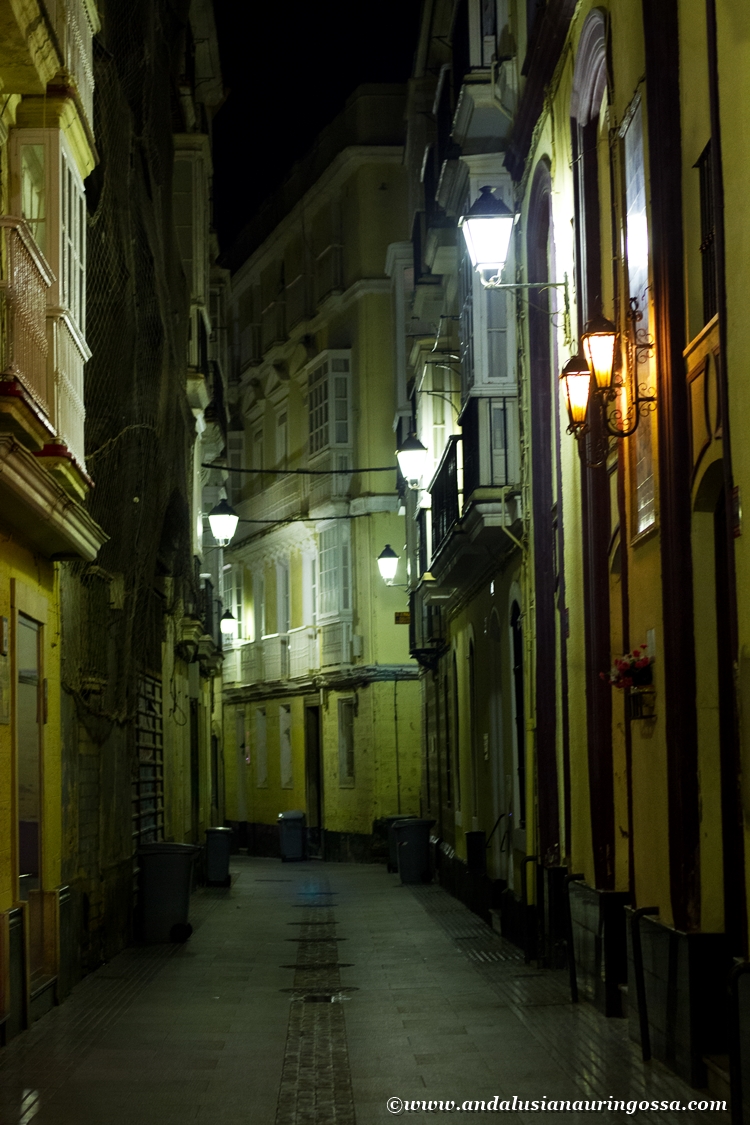
Cadiz by night

Though Cadiz charmed me with all its light and colour, it's quite possibly even more beautiful by night.


That's when its run-down charm really comes to life in a magical way.


Because Cadiz does not have an airport, many of the tourists that come here are cruise ship passengers. About 300 ocean liners top here for a day, bringing with them about 400 000 tourists. As the evening falls they will have returned to their ships and continued their journey and the locals start populating city's  cafes and tapas bars.


The narrow streets of old city are completely empty and one gets to explore them all by themselves. A laughter echoes in the air from one of city's many squares, where people gather until late at night.


Grandmothers catch up with the latest gossip from the wrought iron balconies from opposite sides of the streets. Somewhere laundry is being hung. Over there someone is deep in his thoughts, smoking the last cigarette of the evening.


Imagination starts racing on the dimly lit cobble stoned alleys. There's something about the ambiance that echoes 1920's Paris. Any moment one would expect a Ford A-model pull up from around the corner, emptying a decadent bunch of people on the street in their search of a speakeasy. Gentlemen in their dapper suits carrying bottles of Champagne, giggling ladies with curly hair and long pearl strands.


Cadiz is magical. 


At the end of one street there's a shop that's still open. A Chinese group is comparing the prices of bottles of whisky. I turn around. I'm not ready for this spell to be broken; to join the rest of the world. I want to stay in this moment and hold on to this feeling of having all this all to myself. 


I emerge from my thoughts smiling and continue my expedition. Ooh, I wonder what's behind that corner...!


* The trip was organized in collaboration with Cadiz Tourism *

__________________


ANYONE FOR SECONDS?


SHARING IS CARING!

Sharing is caring Share to Facebook Share to Twitter Email This Pin This

Wednesday, 18 May 2016

Cadiz - city of light, colour and watchtowers

With population of only 120 000 Cadiz feels instantly welcoming and homey. But frustrating, too. In the first 2 days I always seem to be at the wrong place though my hotel is located right next to City Hall Square Plaza Ayuntamiento, located between the new and Old Cadiz. 

Then I remember the troubles I experienced in Tunis (and, in all honesty, in every single city I've ever visited), which I explained away with theory (than in my own head genuinely made sense) that midgets had been up all night (again), relocating all the streets...

Yep, my legendary sense of direction's got the best of me (again) - I've been holding the map upside down. 


Cadiz is built in the shape of a hand. Its narrow arm, on both sides surrounded by the sea, houses the new Cadiz. The old Cadiz, with barrios, her ancient neighbourhoods, spreads around the hand, located on the shores of Atlantic.

Those different coloured lines painted on the cobble stones mark diferent sightseeing routes making their way through the old city. Convenient. Though I, of course,  only learnt that after I'd finally managed to find myself on the map...


And sights there are to see - Cadiz is, after all, the oldest continuously inhabited city in Spain and the whole Southern Europe. The names comes from the Arabic name for the city, Qadis, which was derived from the Latin name for a fortress. But all this can be traced back to the Phoenicians, that famous sea-faring nations. 

They were the ones who founded the city 1100 BC and the city was of great significance to them. The only Phoenician sarcophagi ever discovered in Spain, were discovered here. Apart from a couple of others found in Sicily, they are the only to ever surface in Europe at large. 


The male coffin was addicentally discovered in 1887. The archaeologist who found it remained, until his death, convinced there had to be a female one somewhere out there, too (cherchez la femme!) and sure enough - almost a hundred years later one was found.  You'll never guess where, though: underneath the house that archaeologist had lived in that now had been torn down.

Both of these sarcophagi are now located in Cadizin archaeological museum (another interesting detail about the museum is, that the admission is free for all EU citizens).


After the Phoenicians the city served as Roman naval base, followed by a Visigoth Period. From 711 onwards the city was ruled by Moorish conquerors until King Alfonso X The Wise reconquered the city in Reconquista of 1262.

Much like elsewhere in Andalusia, the legacy of the Arab conquerors lives on in the local architecture so don't forget to peer into the courtyards and hallways, covered in these amazing azulejos, ornamental Andalusian tiles. 


The centuries after Reconquista saw Cadiz blossom. Christopher Columbus set sail here for his second and fourth journey to the New World and following those trips Cadiz only grew more important. It became an important port for trade which also had its downside: it subsequently became a major target for attacks by the English.

In 1587 certain Francis Drake invaded the port for three days, capturing six ships, destroying further 31 and delaying the Spanish Armada's departure by a whole year.


Casa de Contratación, House of Trade that oversaw the trade between Spain and Americ,a was initially located in Seville, but was later relocated to the logistically more ideal Cadiz. In the 18th century the city was responsible for a whopping 75 percent of the  trade between the two countries. 

The importance of sea-faring and trade is visible in city's architecture, too: Cadiz is also known as the city of watchtowers. 

(I doubt that's why Jehovah's Witnesses were out in full force with their Watchtowers, however, but they were - all over the city.)


Back in 18th century there were 160 watchtowers in the city, out of those 126 are still standing. The merchants and nobility were busy building incredible town houses out of which each one housed towers where the watch men would keep an eye on the approaching ships. 

A typical example is this Casa del Almirante, built in 1690. This four-storey delight, dripping with red and white marble, stands in the Old City close to the City Hall Square and completely captured my heart. Even more so after I learnt it's actually for sale. 

What a fine place this would make for that little commune of ours, don't you think?


What has proven to be problematic with these buildings is their protected status. This means that all the restoration is regulated by strict rules which make the process one very costly and time-consuming enterprise. This usually scares off even the most persistant of boutique hotel entrepreneurs.

One tower that is open for the public, too is Torre Tavira, which offers beautiful panoramic views over the entire Cadiz.


Should you need a cooling breeze, head over to popular Park Genovés, famous for its tree sculptures. Columbus himself is told to have brought back some of the old, exotic trees found in Cadiz still today. 


Elsewhere in Spain the people of Cadiz are known as gaditanos; a name derived from city's ancient name. They're famous for their fun-loving nature and zest for life. Part of this is definitely down to the annual Carnival - the one in Cadiz has a reputation as the wildest one in the whole of Spain. 


Gaditanos are always said to be ready to party, enjoy good food and wine and their friends' company late into the night.

(No wonder I felt so at home, then!)


I've also heard Cadiz being called the Havanna of Europe. No wonder - Cadiz is such a celebration of light and colour. 


That joie de vivre really bubbles in the air. And it is catchy. 

I'd go back tomorrow if I could. How about you guys? Familiar with the charm of Cadiz yourselves? What were your favourites?


__________________


ANYONE FOR SECONDS?


SHARING IS CARING!

Sharing is caring Share to Facebook Share to Twitter Email This Pin This